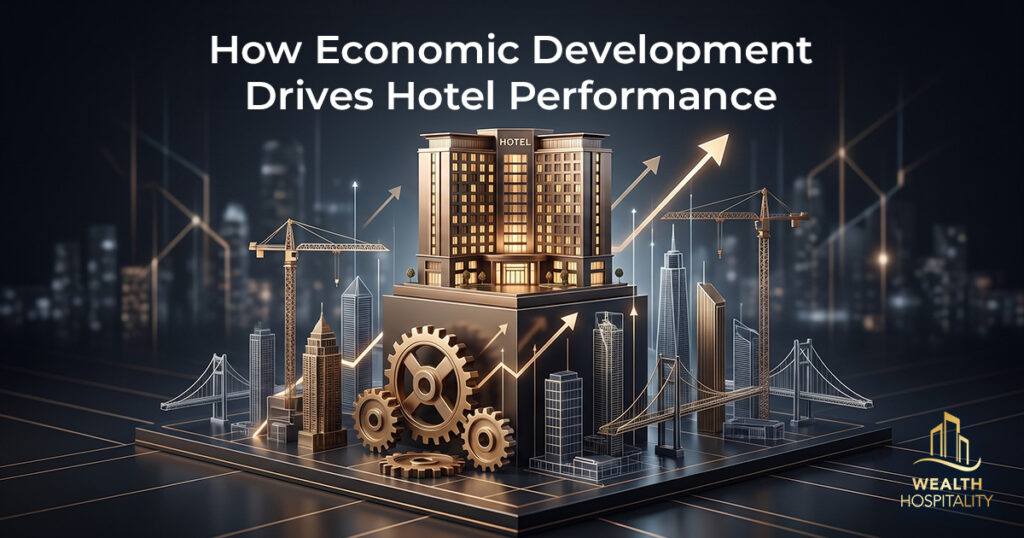
When most people think about what makes a hotel successful, they often focus on the property itself. Location, amenities, guest rooms, and brand affiliation all play important roles. However, some of the most important factors influencing a hotel’s performance exist beyond the property line.
Hotels are closely connected to the economic activity occurring within their surrounding communities. New employers, healthcare systems, universities, infrastructure projects, and tourism attractions all contribute to lodging demand in different ways.
For investors, understanding these economic drivers is an important part of evaluating hospitality opportunities. Strong hotel performance is rarely the result of a single factor. Instead, it is often the product of multiple demand generators working together to create consistent occupancy throughout the year.
What Is Economic Development?
Economic development refers to activities that support growth within a community, region, or market.
Examples may include:
- New business expansion
- Manufacturing investments
- Infrastructure improvements
- Healthcare growth
- Educational institutions
- Tourism initiatives
- Commercial development
- Population growth
As communities grow and attract new investment, the need for lodging often grows alongside them.
Employees travel. Vendors visit job sites. Families attend graduations. Patients seek specialized healthcare. Tourists explore destinations. Each of these activities contributes to hotel demand.
Why Hotel Demand Is Different
Unlike many forms of commercial real estate, hotels rely on a continuous flow of visitors.
A hotel’s success depends on attracting guests every day, every week, and every season.
Because of this, hospitality developers pay close attention to the factors that bring people into a market.
The strongest hotel markets often benefit from multiple demand generators rather than relying on a single source of business.
When demand comes from several different sectors, hotels may be better positioned to navigate changing economic conditions.
Healthcare Systems Create Consistent Demand
Healthcare is one of the most overlooked drivers of hotel performance.
Major hospitals, specialty treatment centers, and regional healthcare networks attract visitors from surrounding communities and neighboring states.
Hotel guests may include:
- Patients traveling for treatment
- Family members supporting loved ones
- Traveling nurses
- Physicians and specialists
- Medical equipment vendors
- Pharmaceutical representatives
- Healthcare consultants
Unlike seasonal tourism, healthcare-related travel often occurs throughout the year.
As a result, communities with strong healthcare systems frequently provide reliable lodging demand for nearby hotels.
Universities and Colleges Support Year-Round Activity
Educational institutions generate a surprising amount of hotel demand.
Colleges and universities attract visitors for:
- Student move-in and move-out periods
- Graduation ceremonies
- Athletic competitions
- Academic conferences
- Alumni events
- Campus tours
- Parent visits
Large universities often host events that bring thousands of visitors into a community throughout the year.
Hotels located near educational institutions can benefit from recurring demand that extends well beyond the traditional academic calendar.
Corporate Growth Fuels Business Travel
Business travel remains an important contributor to hotel performance in many markets.
When companies expand operations, open facilities, or relocate employees, hotel demand often follows.
Corporate-related lodging demand may come from:
- Sales professionals
- Executives
- Consultants
- Trainers
- Vendors
- Contractors
- Job candidates
Even in communities that are not major tourism destinations, business activity can create significant demand for hotel rooms.
Markets with diverse employer bases often provide a steady stream of corporate travelers throughout the year.
Manufacturing and Industrial Development Matter
Manufacturing facilities, distribution centers, and industrial projects can have a substantial impact on local lodging demand.
Large projects often require months or years of support from contractors, engineers, project managers, and specialized technicians.
These workers frequently require temporary lodging while projects are underway.
In many growing markets, industrial development becomes a major contributor to hotel occupancy long before a project reaches full operation.
This is one reason hospitality developers closely monitor economic development announcements and business expansion plans when evaluating opportunities.
Tourism Remains a Powerful Driver
Tourism is often the most visible source of hotel demand.
Visitors travel for a variety of reasons, including:
- Vacation travel
- Outdoor recreation
- Entertainment
- Cultural attractions
- Festivals
- Sporting events
- Family gatherings
Strong tourism markets can generate substantial occupancy and revenue for hotels.
However, experienced developers often prefer markets supported by both tourism and non-tourism demand sources.
This balanced approach can help create more consistent performance throughout the year.
Government and Military Activity
Many communities benefit from the presence of government agencies, military installations, or public-sector organizations.
These entities generate travel from:
- Government employees
- Contractors
- Consultants
- Military personnel
- Families
- Event attendees
Government-related travel often provides an additional layer of lodging demand that supports local hospitality markets.
Communities with significant military or government presence frequently demonstrate strong long-term demand characteristics.
Infrastructure Projects Bring Visitors to Growing Markets
Road construction, transportation improvements, utility projects, and public infrastructure investments often attract large numbers of workers and contractors.
These projects may last months or years, creating extended lodging needs during development.
As infrastructure expands, communities often become more attractive to future employers and residents, creating additional long-term demand opportunities.
Hospitality developers frequently evaluate both current and planned infrastructure projects when analyzing a market.
Population Growth Supports Long-Term Performance
Population growth often serves as a strong indicator of future economic activity.
As communities attract new residents, demand increases for:
- Healthcare services
- Education
- Retail development
- Restaurants
- Professional services
- Housing
This broader economic activity creates additional reasons for people to travel into the market.
Growing populations often signal healthy local economies that can support long-term hospitality demand.
Why Diversified Demand Matters
One of the most important concepts in hospitality investing is demand diversification.
A market that relies entirely on a single employer, industry, or attraction may face greater challenges if conditions change.
By contrast, markets supported by multiple sectors often demonstrate greater stability.
Consider a community that benefits from:
- A regional healthcare system
- A major university
- Manufacturing growth
- Tourism attractions
- Corporate offices
If one demand source experiences a slowdown, the others may continue generating hotel business.
This diversification is often a key factor in successful market selection.
How Hospitality Developers Evaluate Markets
Before pursuing a new project, experienced developers conduct extensive market analysis.
Areas commonly evaluated include:
- Population trends
- Employment growth
- Economic development activity
- Healthcare presence
- Educational institutions
- Tourism statistics
- Infrastructure investment
- Competitive hotel supply
The goal is to identify markets where long-term demand fundamentals support sustainable hotel performance.
While no investment is without risk, strong market research helps developers make informed decisions about where opportunities may exist.
How Wealth Hospitality Group Approaches Market Selection
At Wealth Hospitality Group, market selection is a critical part of our development process.
Our team evaluates economic drivers, demographic trends, business activity, healthcare systems, educational institutions, and tourism demand when assessing potential opportunities.
We believe successful hospitality projects begin with strong market fundamentals. By focusing on growing communities supported by diverse demand generators, we seek to develop properties positioned for long-term success.
Final Thoughts
Hotel performance is influenced by far more than the property itself. Economic development plays a significant role in creating the demand that supports occupancy, revenue, and long-term growth.
Healthcare systems, universities, corporate expansion, manufacturing investment, tourism, government activity, and infrastructure development all contribute to a market’s hospitality ecosystem.
For investors, understanding these drivers can provide valuable insight into how hotel markets function and why certain communities consistently attract new hospitality development.
Strong hotels are often built in strong markets. Recognizing the economic forces behind those markets is one of the most important steps in evaluating hospitality real estate opportunities.
Interested in learning more about how market fundamentals influence hotel development? Contact Wealth Hospitality Group to learn how our team identifies and evaluates opportunities in growing markets across the United States.