
For many investors exploring hospitality real estate, the industry’s terminology can feel unfamiliar at first.
While traditional real estate investments often focus on metrics such as rental income, cap rates, and cash flow, hotels use a different set of performance measurements to evaluate success.
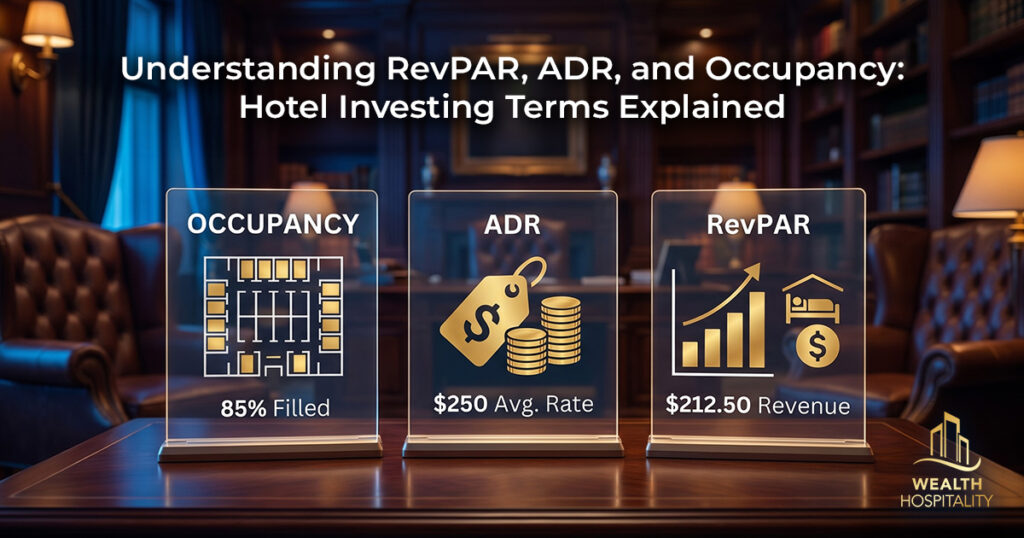
Three of the most important metrics in hospitality are Occupancy, Average Daily Rate (ADR), and Revenue Per Available Room (RevPAR). These measurements help owners, operators, lenders, and investors understand how effectively a hotel is performing within its market.
Whether you’re new to hospitality investing or simply looking to better understand the industry, learning these core metrics is an important step toward evaluating hotel opportunities with greater confidence.
Why Hotel Performance Metrics Matter
Hotels operate differently than most other forms of real estate.
Unlike apartment communities, office buildings, or industrial properties that often rely on long-term lease agreements, hotels generate revenue one night at a time.
As a result, performance can fluctuate based on:
- Market demand
- Business travel
- Tourism activity
- Special events
- Seasonal trends
- Economic conditions
Because of this dynamic environment, hospitality professionals rely on specific metrics to track performance and make informed operational decisions.
Understanding these measurements provides valuable insight into how a hotel is performing and how it compares to its competitors.
What Is Occupancy?
Occupancy is one of the simplest and most widely used hotel performance metrics.
It measures the percentage of available rooms that are occupied during a specific period.
Occupancy Formula
Occupancy = Rooms Sold ÷ Rooms Available × 100
For example:
If a hotel has 100 rooms and sells 80 rooms on a given night, its occupancy rate is 80%.
Why Occupancy Matters
Occupancy helps determine how effectively a property is attracting guests.
Higher occupancy often indicates strong demand within a market, though occupancy alone does not tell the full story.
A hotel can fill every room in the building, but if those rooms are being sold at very low rates, overall financial performance may still fall short of expectations.
This is why hospitality professionals evaluate occupancy alongside other metrics.
What Is Average Daily Rate (ADR)?
Average Daily Rate, commonly referred to as ADR, measures the average price paid for occupied rooms during a specific period.
ADR Formula
ADR = Room Revenue ÷ Rooms Sold
For example:
If a hotel generates $12,000 in room revenue from 80 occupied rooms, the ADR would be:
$12,000 ÷ 80 = $150
In this example, guests paid an average of $150 per room.
Why ADR Matters
ADR helps operators understand pricing performance.
A growing ADR may indicate:
- Strong demand
- Effective revenue management
- Market growth
- Successful positioning against competitors
Hotels continually evaluate pricing strategies to balance room rates with occupancy goals.
The objective is not simply to fill rooms but to maximize overall revenue.
What Is RevPAR?
Revenue Per Available Room, commonly known as RevPAR, is often considered one of the most important performance metrics in the hospitality industry.
RevPAR combines occupancy and room rate performance into a single measurement.
RevPAR Formula
RevPAR = Room Revenue ÷ Available Rooms
or
RevPAR = Occupancy × ADR
Using the previous example:
- Occupancy = 80%
- ADR = $150
RevPAR = $120
Why RevPAR Matters
RevPAR provides a more complete picture of performance than occupancy or ADR alone.
Consider these two scenarios:
Hotel A
- Occupancy: 95%
- ADR: $90
Hotel B
- Occupancy: 80%
- ADR: $140
At first glance, Hotel A appears stronger because more rooms are occupied.
However, Hotel B may generate greater revenue despite lower occupancy because its room rates are significantly higher.
RevPAR helps investors and operators evaluate how effectively a hotel balances occupancy and pricing.
Why Looking at One Metric Isn’t Enough
One of the most common mistakes new investors make is focusing on a single performance measurement.
Each metric tells only part of the story.
High Occupancy Isn’t Always Better
A hotel operating at extremely high occupancy may actually be leaving revenue on the table if rates are too low.
High ADR Isn’t Always Better
A hotel charging premium rates may struggle if occupancy falls too far below market averages.
RevPAR Provides Context
RevPAR helps connect these two variables and provides a more balanced view of performance.
Experienced hospitality professionals typically evaluate all three metrics together when analyzing a property’s health.
How Revenue Management Impacts Performance
Revenue management is the process of adjusting room rates based on demand and market conditions.
Hotels frequently modify pricing based on factors such as:
- Local events
- Holidays
- Seasonal demand
- Competitor activity
- Booking trends
- Group reservations
This flexibility allows hotels to respond quickly to changing conditions.
For example, a hotel may increase rates during a major sporting event or convention when demand is expected to rise.
Conversely, rates may be adjusted during slower periods to encourage bookings.
Effective revenue management plays a major role in maximizing ADR, occupancy, and RevPAR.
Understanding Market Comparisons
Performance metrics become even more valuable when compared to market averages.
Hospitality professionals often ask questions such as:
- Is occupancy above or below market competitors?
- Is ADR increasing faster than the market?
- Is RevPAR outperforming comparable hotels?
A property’s performance relative to its competitive set often provides important insight into operational effectiveness and market positioning.
Strong results within a growing market may indicate that a hotel is successfully capturing demand.
Beyond Occupancy, ADR, and RevPAR
While these three metrics are among the most important in hospitality, they are not the only measurements investors evaluate.
Other factors may include:
- Operating expenses
- Net operating income
- Market growth trends
- Guest satisfaction scores
- Brand performance
- Local economic conditions
Successful hotel investing requires understanding both property-level performance and the broader market environment.
The strongest opportunities often combine effective operations with favorable market fundamentals.
Why Market Fundamentals Still Matter
Even the best-performing hotel metrics should be viewed within the context of the surrounding market.
Factors such as:
- Population growth
- Healthcare systems
- Universities
- Corporate expansion
- Tourism activity
- Infrastructure investment
all influence long-term demand.
A hotel’s performance metrics often reflect the strength of these underlying economic drivers.
This is why experienced hospitality developers spend significant time evaluating market fundamentals before pursuing a project.
How Wealth Hospitality Group Evaluates Opportunities
At Wealth Hospitality Group, performance metrics are one component of a broader evaluation process.
Our team analyzes market conditions, demand generators, economic development activity, brand affiliation, operational considerations, and long-term growth trends when assessing opportunities.
While Occupancy, ADR, and RevPAR provide valuable insight into hotel performance, they are most meaningful when considered alongside the factors that drive demand within a market.
Understanding both the numbers and the story behind them is essential to making informed hospitality investment decisions.
Final Thoughts
Occupancy, ADR, and RevPAR are foundational metrics within the hospitality industry.
Occupancy measures how many rooms are being sold. ADR measures the average rate guests are paying. RevPAR combines both figures to provide a more complete picture of revenue performance.
Together, these metrics help investors, operators, and developers evaluate how effectively a hotel is performing within its market.
For investors interested in hospitality real estate, understanding these terms is an important first step toward evaluating opportunities and gaining confidence in the industry’s unique operating model.
Interested in learning more about hospitality real estate and hotel performance? Contact Wealth Hospitality Group to learn how our team evaluates opportunities in growing markets across the United States.